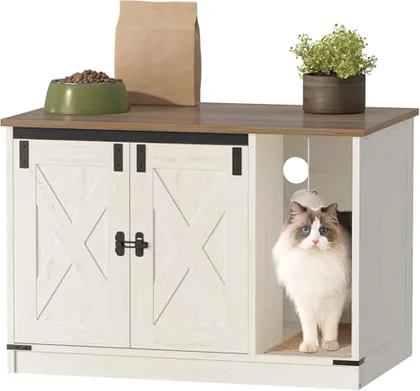
Cat Litter Box Enclosure
$74.99
Ventilation, width, entry side and the honest limits of a cabinet, written from the pieces we build.
By the Hzuaneri workshop · published 28 August 2026 · updated 28 August 2026
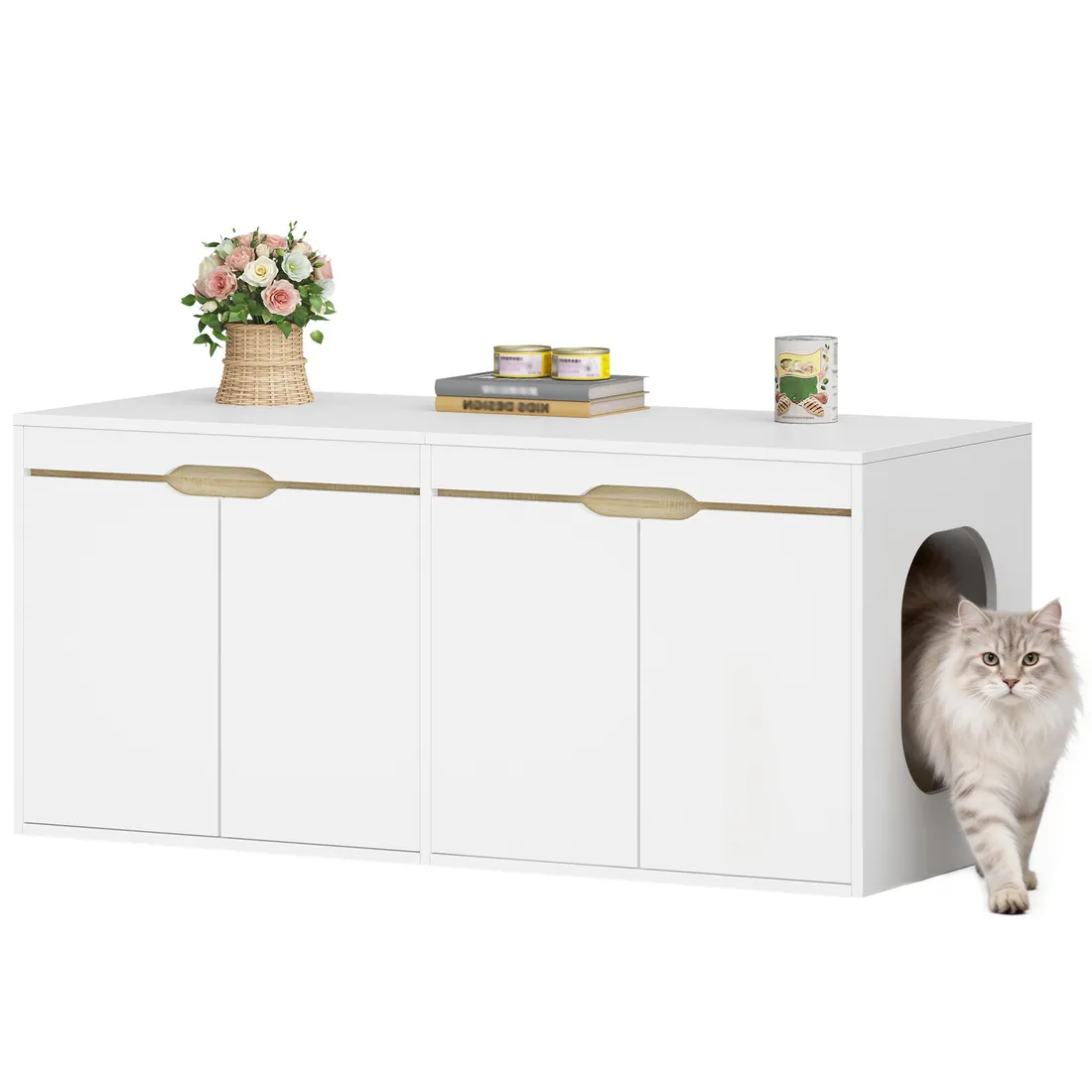
You love your cat. You do not love looking at a plastic tray of litter from across the room. You are not alone in this. The litter box is the one thing in the house that does its job well and looks terrible doing it.
We started here too. In 2016, we made a single cabinet that hid a litter box. That one piece came from a real kitchen, ours, where a plastic tray sat visible from the table. It worked. The cat used it. The room felt like a room again.
Ten years on, the Hzuaneri lineup covers 46 cabinets built for exactly this purpose. They range from 18 to 38 inches wide, from $59.99 to $201.86. What we learned in that time is that hiding a litter box is never just about hiding it. It is about air, size, access, and what a cat will actually walk into.
This guide walks through every part of that decision. We will tell you what works, what smells, and when the right answer might be to leave the tray out in the open.
You can buy the best-looking cabinet in the range. If the cat will not step inside it, you bought a side table. That is the rule. Cats do not negotiate about bathrooms.
A cat refuses an enclosed box for reasons that make sense to a cat. The space is too tight to turn around. The litter is too shallow or too deep. The box has one exit and the cat feels trapped. The lid traps ammonia inside, and a cat's nose is far more sensitive than yours.
The tray inside the cabinet is still a litter box. It still needs to be scooped. It still needs to be the right size. Putting a too-small tray inside a cabinet does not make it bigger. It makes it a too-small tray in the dark.
A cat needs to stand at full length, turn around, and dig. For most adult cats, that means a tray at least 18 inches long and 14 inches wide. A large cat, a Maine Coon, a Ragdoll, a hefty tabby, needs more.
The cabinet must hold that tray with room to spare. If the tray presses against the walls, litter spills every time the cat scratches. If the entry hole is too small, the cat will not duck through it.
Most of our cabinets are 20 to 24 inches deep. That is the number that matters. Depth decides whether a large cat can turn around inside without banging a shoulder on the wall. Width gives you room for the tray plus a few inches of clearance, which keeps litter from spraying out the door.
If you measure anything, measure your cat from nose to rump when stretched out walking. Add four inches. That is your minimum tray length. Then measure the cabinet interior, not the exterior width from the product page. The walls, hinges, and door thickness all eat into the space inside.
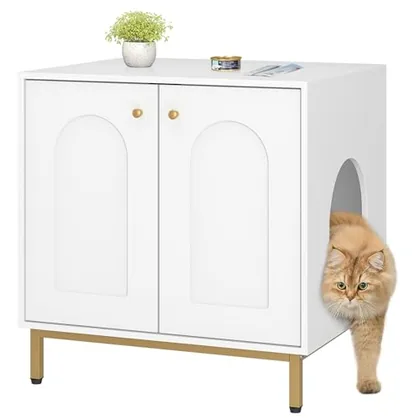
24" · metal
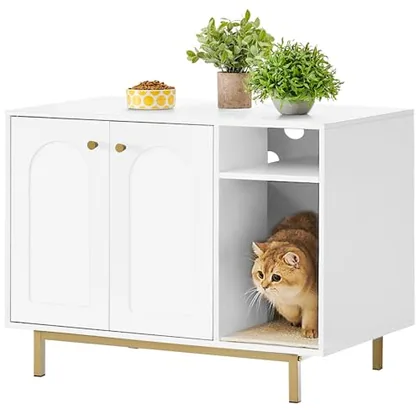
metal
A closed box traps ammonia. Ammonia is heavier than air and settles at the bottom, exactly where the cat puts its head to dig. A cat that walks into a cabinet, sniffs, and backs out is telling you the air is bad.
Ventilation means airflow through the cabinet. Not a fan. Not a gadget. Just openings that let air move. Without airflow, the cabinet becomes a gas chamber. The cat breathes its own waste. It stops using the box. You blame the cabinet. The cabinet was not the problem, the lack of air was.
Our pieces handle this differently depending on the entry style. Side-entry cabinets typically have an open passage or a cutout that stays open all the time. Front-entry designs with a door often have slatted panels or gaps at the base. Top-entry cabinets vent through the lid gap and the entry hole itself.
What you should check: can air move through the cabinet when the door is closed? Put your hand inside on a warm day. If the air feels still and sharp, add ventilation. A few 2-inch holes in the back panel, covered with a soffit vent from the hardware store, can change whether a cat uses the box or the rug.
In a single-cat home, one entry is usually fine. The cat knows the room. It can hear what is coming. It feels safe enough to turn its back on the door and do its business.
In a home with two or more cats, one entry is a trap.
A cat in a box cannot watch the door and eliminate at the same time. Another cat can sit outside the entrance and wait. The cat inside knows this. It may refuse to enter at all. Or it may go in, get cornered, and come out swinging. Then you have a litter box problem and a behavior problem.
The two-exit rule is simple: any enclosed box in a multi-cat household needs a way in and a separate way out. That can be two cutouts on different sides. It can be a top entry paired with a side exit. What it cannot be is one door at the front and nowhere else to go.
Some of our cabinets are designed with this in mind. Others can be modified, a second cutout in the side panel, finished with a trim ring, gives the cat an escape route. If you are buying for a multi-cat home, look for a piece deep enough that the tray does not block the second exit path.
| Width band | Pieces | Price from | What it suits |
|---|---|---|---|
| 18.1-21.2 in | 17 | $59.99 | A tight corner or a single animal |
| 21.2-24 in | 17 | see below | The common case: one room, one animal, room to turn |
| 24-37.6 in | 17 | $201.86 | Two animals, or a piece that doubles as a sideboard |
Widths measured across the 51 pieces in this department.
Across the Hzuaneri collection, the 46 litter box cabinets fall into three entry styles. Each solves a different problem and creates a different one.
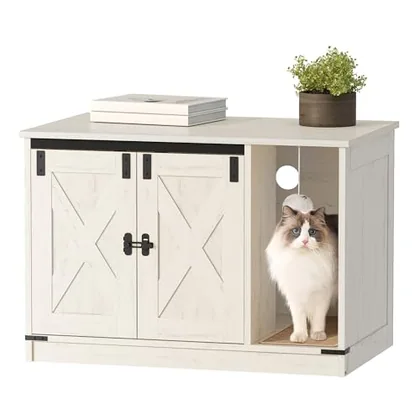
Side entry is the most common. A cutout on one side panel, often framed, lets the cat walk in at floor level. It is the easiest style for a cat to accept. It is also the easiest for litter to track out of, because the cat exits horizontally and kicks litter through the opening.
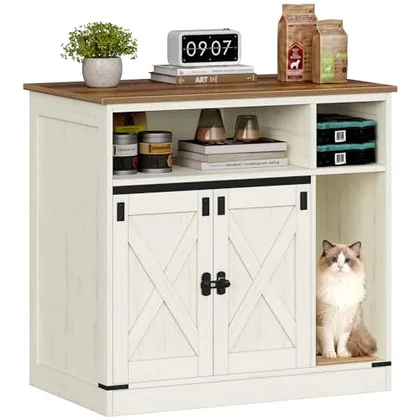
Front entry through a door hides everything when the door is closed. The cat pushes through a flap or a cutout in the door panel. This style keeps litter and odor contained better than an open side entry. The trade-off: the cat must push through a barrier, and some cats will not.
Also, cleaning access matters enormously here, if you have to open a door, reach past it, and lift a tray over a lip, you will scoop less often. And scooping less often is what makes the cabinet smell.
Top entry uses a hole in the lid. The cat jumps up, drops in, does its business, and jumps back out. This style nearly eliminates litter tracking, because the cat exits vertically and most of the litter falls off on the way up. It also keeps dogs out of the box.
The downside: it requires a cat willing to jump, and it is harder to clean. You lift the entire lid, lean over, and scoop down into a box. If the lid is heavy or the cabinet is tall, you will resent it.
Cats have strong opinions about location. Ignore them and the cabinet sits unused.
Do not put the box near the food bowl. A cat does not eat where it eliminates. This is not a preference. It is hardwired. A box within six feet of food will be avoided.
Do not put the box next to the washing machine, the furnace, or anything that kicks on with a sudden noise. A cat startled mid-squat may never return to that spot. The cabinet does not muffle a spin cycle.
Do not put the box in a high-traffic corridor. A cat wants privacy, not an audience. A hallway where people and dogs walk past all day is a terrible location, cabinet or no cabinet.
Do put the box somewhere quiet, with a clear sightline to the room, but not in the middle of the action. A corner of a bedroom, a quiet spot in a home office, a laundry room that is not constantly in use, these work. The cat can hear what is coming and feel hidden without feeling trapped.
The cabinet helps here. It turns a litter box into a piece of furniture, which means you can place it in a living room or a bedroom without it screaming "litter box." That is the whole point. But the placement rules still apply. A beautiful cabinet in a busy hallway is still a litter box in a busy hallway.
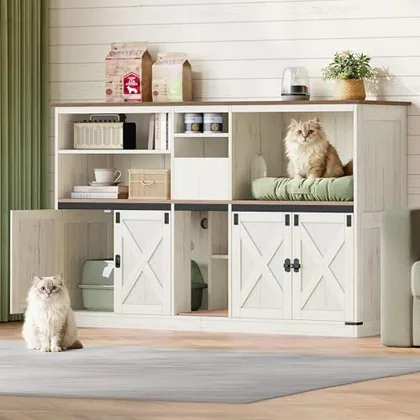
metal
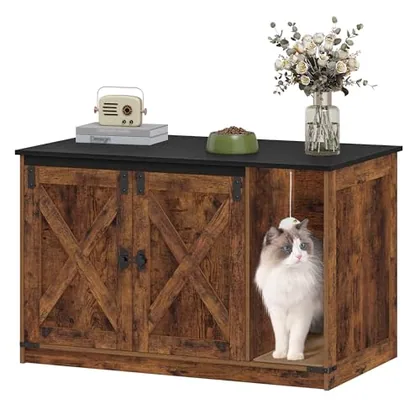
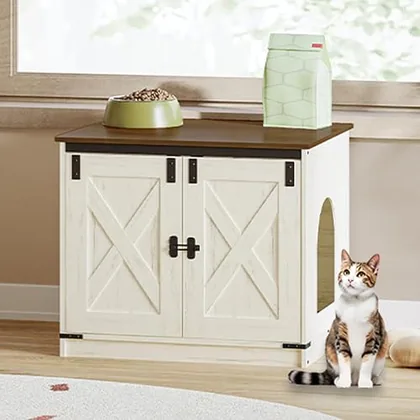
21.6" · particle board
This is the least glamorous part of the decision and the most important. A litter box needs scooping every day. If the cabinet makes that difficult, you will skip days. Skipped days mean ammonia buildup. Ammonia buildup means the cat stops using the box.
A door that swings open fully beats a lid you must lift. With a door, you open it, slide out the tray, scoop, slide it back, close the door. The whole thing takes ninety seconds.
With a top-entry lid, you lift the entire top panel, lean over, and scoop downward. If the cabinet is tall, you are reaching into a hole. If the tray is heavy, you are lifting it at an awkward angle. These pieces work well for tracking control, but they cost you time every single day.
Look for full door swing. Look for a tray that slides out without lifting. Look for an interior floor that is smooth and easy to wipe. If the cabinet has a lip at the bottom, litter will catch there and you will be digging it out with your fingers.
This is where most people go wrong. They buy a cabinet expecting it to stop odor. It does not. The cabinet hides the box. The tray and the litter control the smell.
Ammonia comes from urine. Urine sits in the litter until you scoop it. No cabinet, no matter how tightly sealed, stops that process. A sealed cabinet actually makes it worse: the ammonia concentrates inside, and when you open the door, it hits you in the face. The cat has been breathing it for hours.
Use a clumping litter. Scoop every day. Replace the litter completely on a schedule, every two to four weeks, depending on the litter and the cat. Wash the tray with soap and water between fills. These actions do more for odor control than any cabinet ever will.
Dust is a separate issue. Some litters produce fine dust that coats the inside of the cabinet. The dust is not harmful in small amounts, but it builds up. Wipe down the interior walls when you change the litter. If you use a scented litter, know that the scent is for you, not the cat, and some cats hate it.
The cabinet's job is to look good in your room and give the cat a private place. It is not an air purifier. If you want less smell, scoop more. It really is that simple.
A cabinet does not make a smell disappear. The tray, the litter and the day you last cleaned it do that. What furniture changes is whether the room has to look like a utility area.Hzuaneri workshop notes
The cat tells you. It stops using the box. It goes next to the cabinet instead of inside it. It goes in but does not cover, because there is no room to turn around and scratch. It scrapes the walls of the cabinet instead of the litter, and the sound wakes you up at night.
A cabinet that is too small also traps the cat. If the tray fills the entire interior, the cat has to step directly into the litter from the entry. There is no staging area. No place to stand and assess. The cat hits litter on step one, and some cats hate that.
We see this most often with cabinets under 20 inches deep. They hold a small tray. A small tray works for a kitten or a small adult cat. It does not work for a 12-pound cat with a full-length stride. If you are buying for a cat that size, the 20-inch depth is the floor, not the target. Go deeper if you can.
We make cabinets for litter boxes. We also know that some cats will never use one. That is not a failure of the cat or the cabinet. It is just a fact about that cat.
A nervous cat needs to see the whole room while it eliminates. An enclosed box, no matter how well ventilated, blocks sightlines. The cat feels vulnerable. It holds it. Or it finds a spot behind the couch.
An older cat with arthritis may struggle to step over a high entry lip or jump through a top-entry hole. The cabinet that works for a young cat becomes an obstacle for a 14-year-old with stiff hips.
A cat with a history of urinary issues may associate an enclosed box with pain, because the last time it hurt to pee, it was inside that box. The cat makes the connection and avoids the box forever. You cannot reason a cat out of that.
In all of these cases, the right answer is an open tray in a quiet corner. You can place it inside a cabinet with the door removed, or on a low tray mat that catches litter. The furniture part takes a back seat to the cat's willingness to use the box. A visible tray that gets used is better than a hidden tray that does not.
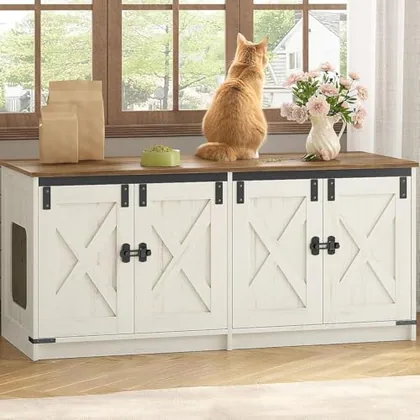
18.1"
18.5"
The Hzuaneri lineup includes 46 cabinets built for litter boxes, from $59.99 to $201.86. They span 18 to 38 inches wide, with most sitting at 20 to 24 inches deep. That depth range covers the majority of adult cats. For large cats, look at the pieces at the deeper end.
The entry styles split across the range. Side-entry cabinets are the most numerous. They work for most cats and most homes. Front-entry pieces with doors offer more concealment and better odor containment between scoops. Top-entry cabinets are fewer but solve specific problems: dogs, heavy trackers, cats that fling litter.
Some pieces double as actual furniture, a side table, a console, a bench. That is the Hzuaneri approach: the piece should belong in the room first and hide the litter box second. The finish, the hardware, the proportions all read as furniture, not as pet supply.
What none of our pieces do: eliminate the need to scoop. Control odor on their own. Work for every cat. Guarantee acceptance. We say this plainly because the alternative is a returned cabinet and a frustrated buyer, and that helps no one.
Here is what to walk through before you choose a cabinet. Write down the answers. Measure twice.
Measure your cat from nose to rump when walking. Add four inches. That is your minimum tray length. Check the interior depth of the cabinet against that number, not the exterior dimensions on the product page.
Count your cats. If you have more than one, you need a second exit or a cabinet design that allows one. If you cannot find a piece with two exits, plan to cut a second pass-through in the side panel.
Look at where the cabinet will go. Is it quiet? Away from food? Not in a hallway? Can you open the door fully without hitting a wall or a piece of furniture?
Think about your own habits. Will you open a lid every day? Will you reach down into a top-entry box? Be honest. The cleaning routine that actually happens is the one that matters.
The Hzuaneri team built this range for the same reason you are reading this guide: we wanted a home that did not look like it belonged to a cat, even though it did. The right cabinet makes that possible. The right information makes it likely. Measure, ventilate, scoop, and let the cat have the final say.
